
Description
📋 What it is
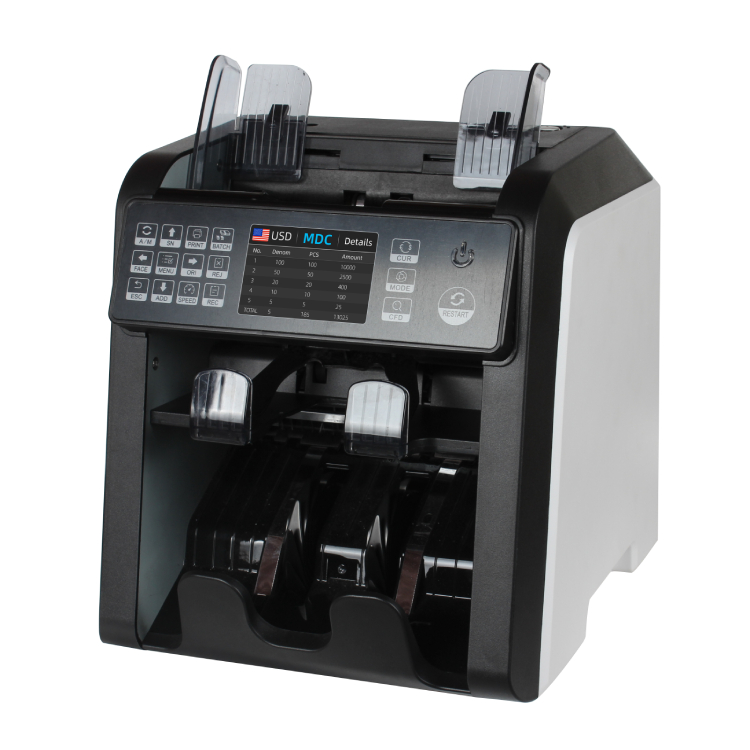
The AL-950 is a high-performance banknote/“value” counter and sorter designed for businesses that handle large volumes of cash, multiple denominations and even multiple currencies. Rather than simply counting “number of bills,” it offers mixed-value counting (adding up the total value of differing denominations), currency recognition, counterfeit detection and sorting.
In short: it’s more than a simple bill counter — it’s a cash-handling machine suited for banks, currency exchange desks, retail branches, large stores or any business with heavy cash flow and the need for accuracy, speed, and security.
🔧 Key Features & Specifications
Here are the major features and the spec details:
Speed & capacity
-
Hopper (input) capacity: up to approx. 500 banknotes in one stack. Skroutz+2Yuanneng Electric+2
-
Stacker (output) capacity: about 200 banknotes. Cronykwt.com+1
-
Reject-pocket capacity: around 50 banknotes (for suspicious, damaged or mixed/denomination bills) in many specs. Alaajeb+1
-
Counting speeds reported: e.g., 800-1000-1200 bills per minute in mixed/denomination mode; up to ~1200 bills per minute in continuous/CTN mode, in some listings up to 1500 bills/min. Yuanneng Electric+2Chuanwei Tech+2
-
Notes size processing: e.g., minimum ~50×110 mm up to ~90×190 mm in one spec. Skroutz+1
-
Power supply: AC 100-240 V, 50/60 Hz; power consumption ≤ ~80 W in many specs. Skroutz+1
Mixed-value, multi-currency counting
-
The AL-950 is designed for “mixed bill” value count: you can load banknotes of different denominations (and often mixed currencies) and it will total the value, rather than you having to sort or manually count each denomination. Bharti+2Yuanneng Electric+2
-
Multi-currency support: Many spec-sheets say it supports a large number of currencies (EUR, USD, GBP, CAD, MXN, CNY, etc). Yuanneng Electric+2Skroutz+2
-
Sorting modes: It can also sort by denomination, orientation (face up/down), currency, version of banknote (old vs new issue) in some configurations. Bharti+1
Counterfeit detection & note quality/validation
-
The “Dual CIS” term (contact image sensor) means it reads images of both sides of each bill for inspection. Yuanneng Electric
-
Detection features include: UV (ultraviolet), MG (magnetic ink), IR (infrared), image, size (dimension), thickness, security line detection, variable ink detection, fluorescence detection, serial number recognition in some models. Bharti+1
-
The machine gives audio/visual alarm when a suspected counterfeit, half‐note, double‐note, or stuck note is detected. Spaceo+1
User interface, connectivity & configuration
-
Many models come with a TFT (colour) display and touch‐panel interface. Cronykwt.com+1
-
Interfaces: USB, RS-232, RJ-11 (some mention SD card) for firmware updates, data export, integration with external display/thermal printers. Chuanwei Tech+1
-
Auto start/stop: once you load bills, it auto starts; after finishing stack it can auto stop. Bharti+1
Dimensions & build
-
Example dimensions: ~279×250×247 mm in one spec. Yuanneng Electric+1
-
Weight around 9.5 kg net in many listings. Chuanwei Tech+1
-
Robust construction suitable for continuous use.
✅ Why this machine could be a great fit for business
Here are the advantages and business use-cases:
-
Efficient handling of large volumes of cash: If you have lots of bills moving through (retail, currency exchange, bank branch, casino, etc), being able to count at ~1000 or more bills per minute saves huge time vs manual counting.
-
Mixed denominations & currencies: Many machines only count number of bills or require you to separate denominations; the AL-950 enables mixed denominations and multiple currencies in one batch, which is time-saving and reduces error.
-
Advanced counterfeit detection: Given the many detection methods and sensors, it offers a higher level of security — crucial for businesses where accepting counterfeit notes is very high cost.
-
Sorting & batch preparation: With built-in batch mode (you can preset say “stack 100 notes” or “stop when total value hits X”), add mode (sum across multiple runs), reject pocket for bad/fake notes — helps in organizing cash for deposits, bank runs, or storage.
-
Data/export capabilities: With USB/RS-232, you can integrate with cash‐management systems, generate reports, track denominations, serial numbers in some cases. Good for audits.
-
Multi-currency support: If you handle different currencies (for example in international travel market, border, duty-free, multi-currency retail) you have flexibility.
-
Space-efficient & reliable: Its size and build mean it can sit on a counter or back‐office desk and run reliably day-after-day, rather than needing large industrial machine.
⚠️ Things to watch / potential drawbacks
No machine is perfect; you should consider the following:
-
Cost: This is a premium machine (with advanced sorting & detection). For small businesses with low cash volumes it may be overkill.
-
Training & setup: To fully benefit (mixed value, multi-currency, sorting by denomination/orientation) you may need to calibrate, choose the right modes, train staff so they use it properly.
-
Maintenance & consumables: With CIS sensors, multi-feature detection, reject pocket etc, maintenance (cleaning sensors, clearing jams, calibration) may be more involved than simple counters.
-
Mixed value counting accuracy: While the machine supports mixed denominations, you should verify that your local currency versions and denominations are supported and regularly updated (some-mention “free currency updates”). Cronykwt.com
-
Space & power: Takes space on your desk/counter; although 9-11 kg is moderate, still heavier than basic models. Also power draw ~80 W means you must include in your power planning.
-
Complexity vs simplicity: If your cash operations are simple (single currency, single denomination, few bills) then a simpler, cheaper model may suffice.
-
Support & parts in your region: Since this is likely imported (China brand), check availability of local support, parts, firmware updates in your country (Rwanda/Kigali) so you don’t end up with downtime.
🎯 How to deploy in your business & tips
Here are some practical suggestions if you consider using the AL-950:
-
Place the machine in a dedicated cash-counting area (back-office or cashier station) where bills from all tills, each shift can be aggregated and counted.
-
Before counting a large stack, sort out obviously damaged or huge crumpled notes and feed smoother notes into the hopper for best reliability.
-
Use the batch mode: For example you might set “stop at every 100 notes” or “stop when value = X amount” to facilitate bundling into bank deposit lots.
-
Use the mixed denomination mode: If your business accepts many denominations (e.g., 5€, 10€, 20€, 50€, 100€), load them together and let the machine compute total value. This avoids manual recounting per denomination.
-
Enable the reject pocket and review any rejected notes: It may be counterfeit, damaged, or a denomination/version the machine doesn’t recognize — keep a log of rejects for audit.
-
Use the connectivity (USB/RS-232) to export totals or integrate with your cash-management or POS system — this improves traceability, especially day-end counts, shift changes.
-
Regularly maintain: Clean the CIS sensors (dust, ink residue), ensure hopper and stacker are clear of jams, keep firmware/currency lists up to date so it recognizes the latest banknotes.
-
Train staff: The reliability of results depends on correct usage (feeding flat, no folded notes, no sticky bundles), and knowing how to switch modes (mixed vs sorted), clear jams, interpret errors.
-
Have a fallback plan: Even such a machine may have downtime or require cleaning — keep a manual counting process ready just in case to avoid business flow disruption.
🔍 Summary statement
The Chuanwei AL-950 is a high-end, high-capability banknote value counting & sorting machine suitable for businesses with significant cash volume, mixed denominations, multiple currencies, and a need for high accuracy and robust counterfeit detection. It goes well beyond basic bill counting, offering mixed‐value totals, sorting, multi‐currency recognition, and advanced detection features.
If your business in Kigali (or Rwanda) deals with many banknotes (especially in EUR, USD or other currencies), needs to quickly process large amounts of cash reliably, wants to reduce human error or counterfeit risk, and can support scanning/maintenance of a sophisticated machine — this is a strong choice.
If, on the other hand, your cash volumes are modest, you handle only one currency, only a few denominations, or have a limited budget/technical support environment — then you might evaluate whether a simpler money counter would be more cost-efficient.
Reviews
There are no reviews yet.