
Description
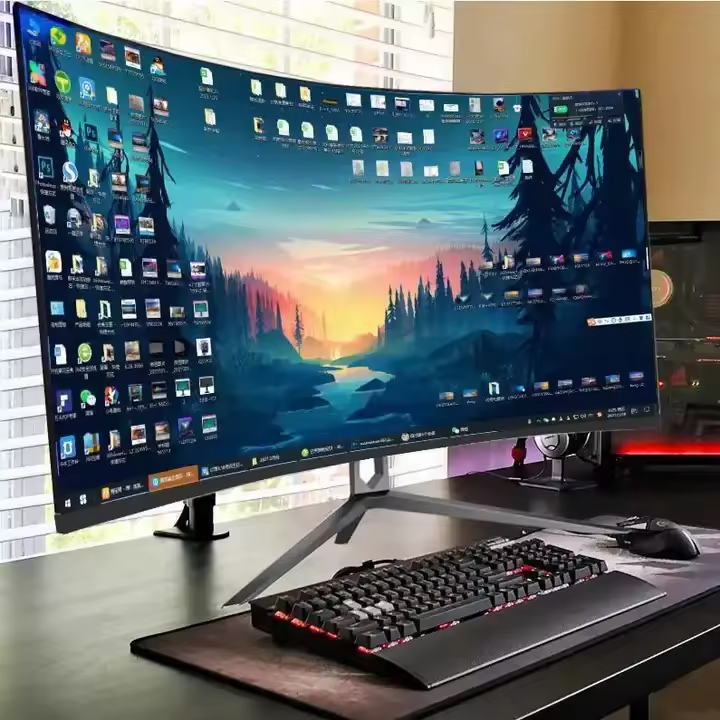
When a monitor is described as “High-quality Wide Screen 240 Hz Monitor 24 Inch 2K 27 Gaming 144 Hz 4K 32 Curve 75 Hz for Business and Gamer Curvo Gaming Monitor”, it is basically communicating that there are multiple size/resolution/refresh-rate tiers, each optimized for different usage patterns — but all aimed at delivering excellent visuals and performance.
Refresh Rate
-
A refresh rate of 240 Hz means the screen updates 240 times per second. That means smoother motion, lower apparent blur, better responsiveness for fast-paced games (FPS, racing) and generally a more “fluid” look. For example, the 24″ monitor with 240 Hz is cited in spec sheets. MSI Storage+3Datika+3MSI Storage+3
-
144 Hz is still very good for gaming and productivity. A 27″ monitor at 2K (2560×1440) resolution and 240 Hz refresh is showcased in specs. ViewSonic+1
-
On the 32″ curved 4K side, although refresh may be lower (e.g., 75 Hz or 144 Hz) the big draw is resolution + screen size + immersion. The curve helps wrap your view and improves immersion.
Resolution & Size
-
A 24″ monitor is compact, takes up less desk space, is good for competitive gaming where you want to see everything clearly without moving your head much. At 1080p or 1440p depending on model.
-
A 27″ monitor with 2K (2560×1440) resolution hits a good “sweet-spot” for many gamers and productivity users: sharper image, more screen real estate, good refresh rate. Example: 27″ 2K 240 Hz spec. ViewSonic
-
A 32″ monitor (especially curved) offers a large view, great for immersive single-player games, simulations, or multitasking/business use (side panels, spreadsheets, code windows), and 4K resolution further sharpens the image though demands more GPU power.
Curve and Business/Gaming Dual-Use
-
Curved monitors (especially in larger sizes like 32″) wrap the display subtly around your field of view, which not only helps immersion in games, but can be beneficial for productivity (less eye movement, feels more “encompassing”). Example: AOC 32″ curved model. FlixCar
-
For a business user: you’ll care about colour accuracy, viewing angles, ergonomics (height/tilt/swivel), connectivity (USB-C for laptop docking, DisplayPort, HDMI, perhaps KVM), comfort (low blue light, flicker-free).
-
For a gamer: you care about refresh rate, response time, adaptive sync (FreeSync/NVIDIA G-Sync), input lag, panel type (IPS/Rapid IPS/VA), resolution vs GPU capability.
🛠 Feature Breakdown – What to check
Here are key features you’ll want to examine when choosing such a monitor:
-
Panel Type & Response Time
-
IPS (or variants like “Rapid IPS”) provide good colour, wide viewing angles, and decent response times. Example: 23.8″ Rapid IPS 240Hz spec from MSI. MSI Storage+2MSI Storage+2
-
Response time (GtG or MPRT) should be low (e.g., 0.5ms, 1ms) to avoid motion blur and ghosting in fast games. Example: 27″ 2K 240Hz spec shows 0.5ms MPRT. ViewSonic
-
-
Resolution & Size Matching
-
Smaller monitors (24″) may be fine at Full HD (1080p) if you’re playing competitive and don’t need ultra-high resolution. E.g., 24″ 240Hz 1080p spec. Datika+1
-
Mid size (27″) tends to pair well with 1440p (2K) resolution and high refresh (144-240Hz) for a fantastic balance. ViewSonic+1
-
Large size (32″) ideally pairs with higher resolution (4K) to keep pixel density comfortable, and a curve improves immersion.
-
-
Refresh Rate & Adaptive Sync
-
Ensure the monitor supports high refresh rate (240Hz for top competitive, 144Hz for general use). The specs show many monitors now support up to 240Hz.
-
Look for AMD FreeSync or NVIDIA G-Sync compatibility (or both) to avoid screen tearing. Example: 27″ 2K 240Hz spec includes FreeSync Premium and G-Sync Compatible. ViewSonic
-
-
Connectivity & Ergonomics
-
Check for DisplayPort, HDMI (preferably HDMI 2.0/2.1 for high refresh/res resolution), USB-C (for laptop docking, power delivery). Example: XG2736-2K spec also includes USB-C 65W. ViewSonic
-
Ergonomics: height adjustment, tilt, swivel, VESA mount support. Especially important for business/productivity usage.
-
Curve design (for larger sizes): helps wrap your field of view and can reduce eye strain over long sessions.
-
-
Colour Quality & Productivity Features
-
For business/productivity: check sRGB/AdobeRGB coverage, calibration, viewing angles, anti-glare coating.
-
For gaming: brightness, contrast ratio, HDR support may matter (though full HDR effect often requires high brightness & panel quality).
-
Eye-care features: low blue light, flicker-free, ergonomic stand.
-
-
Budget & GPU Compatibility
-
If you aim to use 2K at 240Hz, ensure your GPU can output enough FPS to benefit from that refresh. Some users note that going from 144Hz to 240Hz yields diminishing returns if your FPS is far below the refresh. Reddit+1
-
Consider required budget: monitors with 240Hz + 2K or 4K + curve often cost more. Balance needs vs budget.
-
🎯 Example Configurations and Use-Cases
Here are “tiers” reflecting size/resolution/refresh combinations, and how they fit different user types:
-
24″ / 1080p / 240 Hz → Best for competitive esports gamers, tight desk setups, users who prioritise responsiveness and uniform pixel density. Example: ViewSonic XG2431 24″ 240Hz spec. Datika
-
27″ / 1440p (2K) / 240 Hz (or 144 Hz) → Balanced choice for both gaming and productivity: you get sharper resolution (more screen real estate) and high refresh. Example: ViewSonic XG2736-2K 27″ 240Hz spec. ViewSonic
-
32″ / 4K / 75-144 Hz / Curved → Immersive option for single-player games, creative work + gaming, large desk space. The curve adds immersion. Example: AOC 32″ curved spec. FlixCar
🧭 How to Decide for You
-
Desk space & seating distance: If you sit very close, a 24″ or 27″ may be ideal. Larger monitors require more space and a bit more distance.
-
What games you play: If you mostly play fast competitive games (Valorant, CS2), high refresh + low input lag matter more than ultra-high resolution. If you play immersive RPGs/single-player or also use for work, resolution and size matter more.
-
GPU power: Does your PC/console setup support the resolution + refresh you want? For 2K at 240Hz you need a strong GPU.
-
Mixed-use (business + gaming): If you use your monitor for both work (spreadsheets, documents, creative apps) and gaming, a 27″ 2K high-refresh monitor might be the sweet spot.
-
Budget: High refresh + high resolution + large size + curved = premium price. If budget is limited, prioritise the spec that matters most for your main use (refresh or resolution).
-
Connectivity & future-proofing: Make sure it has HDMI 2.1/DP 1.4 for high refresh, USB-C if you connect a laptop, proper stand/adjustments.
-
Ergonomics & comfort: For long sessions (work or play) you want tilt/height adjust, VESA mount, low blue-light, flicker-free.


Reviews
There are no reviews yet.